Over the past three years, the software industry struggled through the chaotic fragmentation of proprietary tool-calling interfaces. Every framework—from LangChain to custom internal agent harnesses—invented its own ad-hoc schema for describing API tools, parsing JSON parameters, and managing execution boundaries. The Model Context Protocol (MCP), open-sourced by Anthropic and rapidly adopted by frontier developers, fundamentally redefines how AI models connect to live tools, internal databases, and developer environments.
In this technical deep dive, we explore how to build production-grade, secure, and low-latency MCP architectures capable of powering enterprise agents handling millions of automated function invocations.
1. The Architectural Shift: Why MCP Matters
Traditional function calling treated tools as static JSON schemas injected into the model prompt on every turn. This paradigm breaks down in enterprise environments for three fundamental reasons:
- Context Window Waste: Loading hundreds of enterprise API definitions into every system prompt consumes tens of thousands of expensive tokens before the user even types a character.
- Lack of Stateful Isolation: Conventional tool handlers run with the same permissions as the host process, making prompt injection attacks catastrophic.
- Incompatible Client Adapters: Moving an agent from Claude to GPT-4o or DeepSeek required rewriting prompt glue code and schema serialization logic.
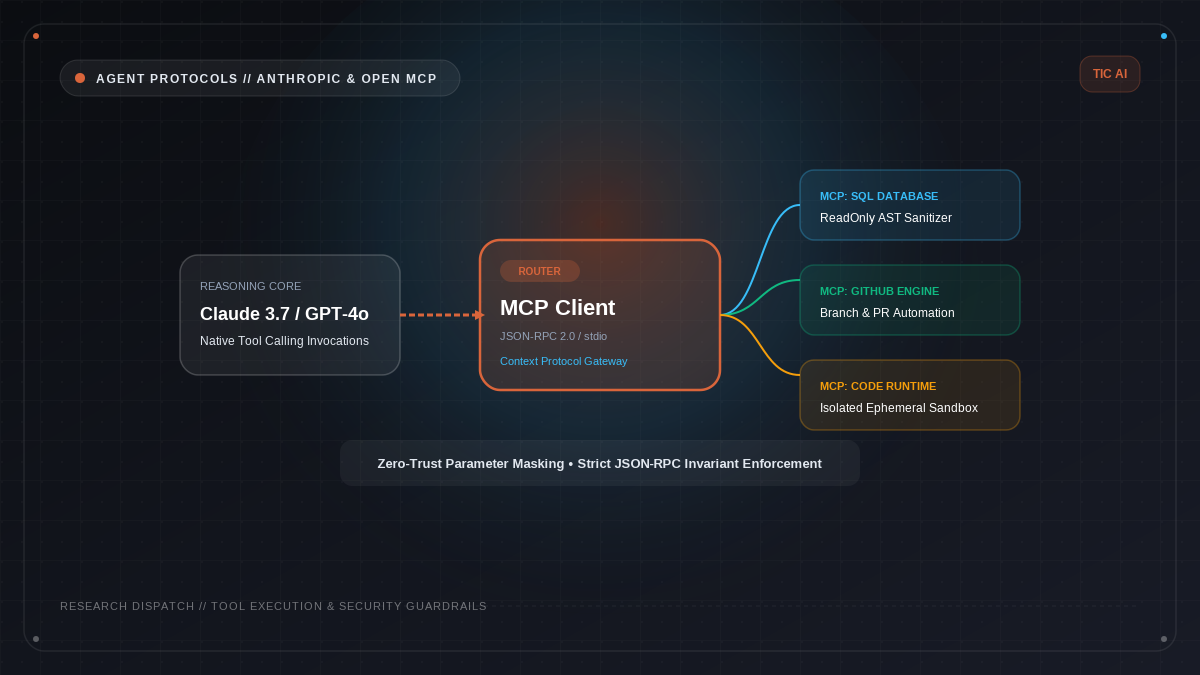
MCP standardizes the separation of concerns through an open JSON-RPC 2.0 protocol. The model acts as the reasoning engine, the MCP Client orchestrates user sessions and access permissions, and decoupled MCP Servers expose tools, dynamic resources, and prompt templates behind standardized transport interfaces.
2. Core Primitives of the Model Context Protocol
The protocol is structured around three foundational capabilities that servers can advertise to clients:
Executable functions that modify system state (e.g., executing code, modifying git repositories, writing records).
Read-only data URIs (e.g., postgres://schema, file contents, log streams) attached to context.
Pre-packaged, versioned workflow templates and role declarations that guide agent execution paths.
3. Transport Layers: stdio vs. Server-Sent Events (SSE)
MCP supports two primary transport implementations depending on deployment topology:
Standard Input/Output (stdio): Best suited for local desktop tools, CLI utilities, and IDE plugins. The client spawns the server as a local child process and communicates via stdin/stdout streams. It provides zero network latency, automatic lifecycle cleanup upon process termination, and airtight local process isolation.
Server-Sent Events (SSE) over HTTP/2: Essential for enterprise cloud infrastructure. The client sends JSON-RPC requests via HTTP POST, and the server streams events, long-running tool updates, and telemetry back over an open SSE connection. On Skyode, our gateway hosts centralized, authenticated SSE microservices so teams share access to PostgreSQL analytics, Kubernetes clusters, and GitHub operations without local credential distribution.
4. Building a Resilient TypeScript MCP Server
Below is an idiomatic implementation of an enterprise-grade MCP server using the official @modelcontextprotocol/sdk. Notice how parameter validation is strictly enforced via Zod schemas before tool execution begins:
import { Server } from "@modelcontextprotocol/sdk/server/index.js";
import { StdioServerTransport } from "@modelcontextprotocol/sdk/server/stdio.js";
import { CallToolRequestSchema, ListToolsRequestSchema } from "@modelcontextprotocol/sdk/types.js";
import { z } from "zod";

const server = new Server(
  { name: "skyode-database-mcp", version: "2.1.0" },
  { capabilities: { tools: {}, resources: {} } }
);

// 1. Define Tool Catalog with strict schema
server.setRequestHandler(ListToolsRequestSchema, async () => {
  return {
    tools: [
      {
        name: "query_read_only_replica",
        description: "Executes sanitized SELECT queries against the read replica database.",
        inputSchema: {
          type: "object",
          properties: {
            query: { type: "string", description: "Read-only SQL query without mutations." },
            limit: { type: "number", description: "Maximum row count, capped at 100.", default: 20 }
          },
          required: ["query"]
        }
      }
    ]
  };
});

// 2. Handle Tool Invocation with Defense-in-Depth
server.setRequestHandler(CallToolRequestSchema, async (request) => {
  if (request.params.name === "query_read_only_replica") {
    const { query, limit } = request.params.arguments as { query: string; limit?: number };

    // Strict validation guard: reject mutations
    const forbidden = /\b(INSERT|UPDATE|DELETE|DROP|ALTER|GRANT|REVOKE|TRUNCATE)\b/i;
    if (forbidden.test(query)) {
      throw new Error("SECURITY_VIOLATION: Mutation operations are prohibited on read replicas.");
    }

    const safeLimit = Math.min(limit || 20, 100);
    const results = await executeReadOnlyQuery(query, safeLimit);

    return {
      content: [
        {
          type: "text",
          text: JSON.stringify({ rowCount: results.length, rows: results }, null, 2)
        }
      ]
    };
  }
  throw new Error(`Tool not found: ${request.params.name}`);
});

const transport = new StdioServerTransport();
await server.connect(transport);
5. Defense-in-Depth Security Guardrails
Granting an LLM tool access introduces severe attack vectors, including Indirect Prompt Injection (where malicious webpage content hijacks the agent's tool invocations) and parameter manipulation. In production systems, never trust the model output blindly. Implement the following four security rings:
Ring 1: Abstract Syntax Tree (AST) Validation
Regex filters can be bypassed with multi-line encoding or nested comments. Parse all SQL, shell commands, and code inputs into AST representations to ensure no secondary commands or destructive flags exist.
Ring 2: Ephemeral Docker & gVisor Isolation
For code execution tools (Python data science, bash commands), spin up stateless lightweight containers destroyed immediately after output capture. Network egress must be blocked by default to prevent credential exfiltration.
Ring 3: Human-in-the-Loop Confirmation for High-Impact Actions
Classify tools into safe (read-only queries, calculations) and privileged (database writes, PR merging, sending emails). Privileged tools require explicit user confirmation before execution.
Ring 4: Zero-Retention Token Masking
Sanitize tool outputs before passing them back to the model context. Strip API keys, session tokens, and personally identifiable information (PII) using fast regex masking.
6. Latency & Token Optimization
When an agent enters multi-turn loops, each tool response is concatenated to the conversation history. In complex tasks involving 10+ tool calls, prompt length expands rapidly, driving up latency and cost exponentially. Mitigate this by:
- Summarizing Intermediate Tool Output: Rather than feeding 500 rows of raw JSON back into context, have the MCP server compute summaries, aggregates, or diffs before returning.
- Preserving Static Tool Boundaries for Prompt Caching: Group system prompts and tool declarations at the top of the request. On Skyode's LiteLLM gateway, Anthropic and Gemini cache these prefixes with up to a 90% cost rebate on subsequent turns.
- Parallel Tool Invocation: Frontier models like Claude 3.7 and GPT-4o support emitting multiple tool calls in a single response. Execute them concurrently via
Promise.all()to cut round-trip latency in half.
7. The Road Ahead
The Model Context Protocol represents the missing interoperability layer in the generative AI ecosystem. By standardizing tool definitions and security boundaries, software organizations can build enduring agents that swap upstream foundation models seamlessly while retaining full enterprise safety compliance. Explore our live Arena AI to benchmark how frontier models execute complex multi-step MCP tasks in real time.
Test this comparison in real-time
Launch Arena AI to evaluate models side-by-side with 20,000 free starter credits.