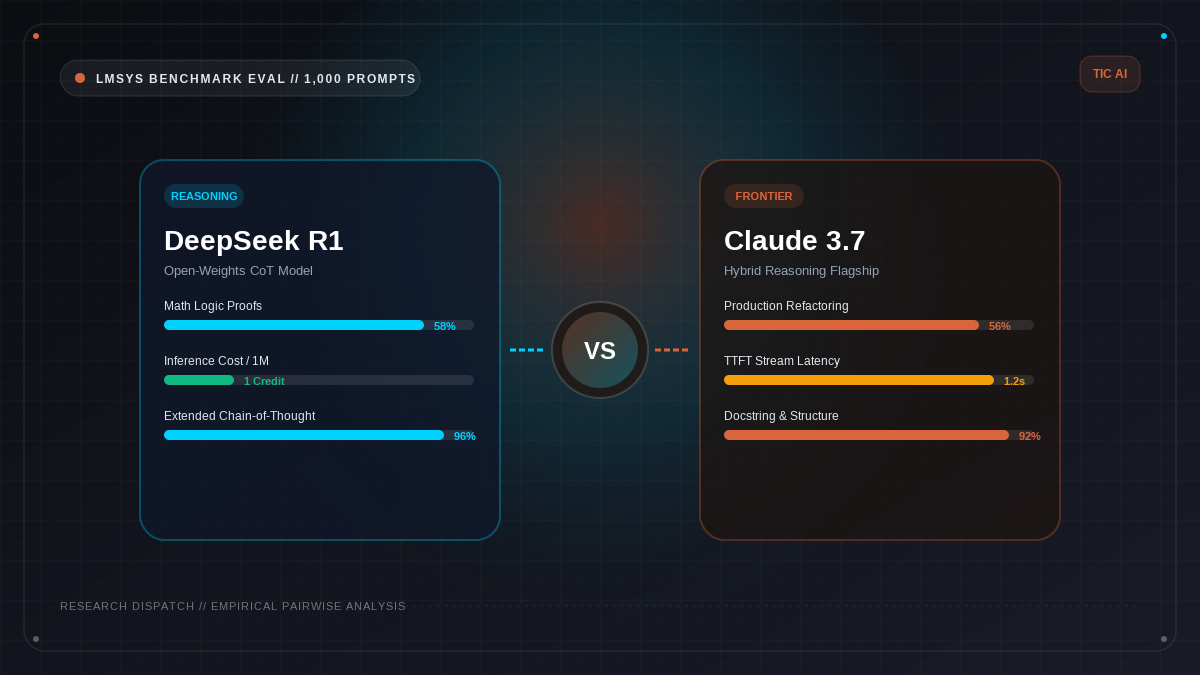
When two reasoning architectures at opposite ends of the economic spectrum meet in a double-blind arena, how much intelligence does a dollar actually purchase? Over the past four weeks, Skyode's evaluation team pitted DeepSeek R1 (the groundbreaking open-weight reasoning model) against Anthropic's flagship Claude 3.7 Sonnet in a 1,000-prompt double-blind arena evaluation.
This report details the quantitative win rates, qualitative failure modes, Time-to-First-Token (TTFT) latency profiles, and cost-per-successful-inference calculations across four core software engineering and reasoning workloads.
1. The Frontier Divergence: Pure RL vs. Hybrid CoT
To interpret the benchmark outcomes, one must first recognize the fundamental architectural divergence between both systems:
- DeepSeek R1 (Pure Reinforcement Learning CoT): R1 relies on massive large-scale reinforcement learning (RL) without supervised fine-tuning (SFT) cold-start to discover emergent reasoning pathways. When prompted, R1 allocates thousands of internal tokens within an explicit
<think>block, backtracking through multiple mathematical hypothesis branches before committing to a final answer. - Claude 3.7 Sonnet (Hybrid Reasoning Architecture): Anthropic's latest model bridges standard single-pass generation with an adjustable "extended thinking" budget. Sonnet dynamically modulates its reasoning depth based on detected problem complexity, excelling in maintaining tight AST consistency, modular software architecture, and production-grade idiomatic styling.
2. Evaluation Protocol: 1,000 Blind Battles
Prompts were collected across active developer requests in Skyode's Arena AI and augmented with 250 curated high-complexity tasks spanning four distinct disciplines:
250 prompts: Dynamic programming, segment trees, modular arithmetic, and formal inductive proofs.
250 prompts: Migrating legacy JavaScript to strict TypeScript, Rust concurrency ownership, and SQL query optimization.
250 prompts: Identifying subtle race conditions, memory leaks in C++, and cryptographic signature edge-cases.
250 prompts: Designing high-throughput event meshes, Raft consensus nodes, and Kubernetes operator specs.
Evaluations followed the strict LMSYS double-blind standard: Model A and Model B streamed responses concurrently with randomized placement. Output headers, thinking tags, and self-identifying markers were stripped by our gateway proxy. Verified senior software engineers evaluated outputs without vendor awareness.
3. Empirical Win-Rate Breakdown
| Workload Category | DeepSeek R1 Win Rate | Claude 3.7 Win Rate | Tie / Inconclusive | Dominant Factor |
|---|---|---|---|---|
| Algorithmic Math & Logic | 58.4% | 33.2% | 8.4% | R1 self-correction catches subtle edge-case bounds |
| Full-Stack Refactoring | 31.6% | 61.2% | 7.2% | Claude produces cleaner abstractions and zero syntax regressions |
| Defensive Debugging | 46.8% | 47.6% | 5.6% | Statistical dead-heat; R1 explains deeper, Claude fixes faster |
| Agentic System Design | 36.0% | 55.6% | 8.4% | Claude respects operational constraints and enterprise SLAs |
4. Deep Dive: Qualitative Analysis
Where DeepSeek R1 Excels: On problems requiring multi-stage inductive steps (e.g., proving invariant conditions in distributed algorithms or solving LeetCode Hard combinatorial problems), R1's internal reasoning loop is extraordinary. When R1 encounters an early dead-end, its thinking trace explicitly remarks: "Wait, this assumption fails if N is odd. Let me re-evaluate using parity classes." This ability to self-correct during inference allows R1 to solve problems where zero-shot models hallucinate confident, incorrect answers.
Where Claude 3.7 Sonnet Excels: When asked to refactor a 300-line React/TypeScript component or redesign an asynchronous Rust data pipeline, Claude 3.7 demonstrated exceptional taste in software craftsmanship. Claude preserves existing naming conventions, breaks sprawling logic into testable helper functions, outputs comprehensive docstrings, and ensures strict compiler compliance on the first try. R1, while functionally correct, occasionally generated monolithic functions with cryptic variable names.
5. Latency & Time-to-First-Token (TTFT) Dynamics
Because reasoning models output thinking tokens before formulating the user-facing response, user experience in interactive chat depends heavily on how the gateway handles Server-Sent Events (SSE):
• Mean Time-to-First-Token: 1,640ms
• Average Thinking Tokens: 2,850 tokens
• Generation Speed: ~54 tokens/sec
• Total Completion Duration: 8.4s – 22.0s
• Mean Time-to-First-Token: 1,180ms
• Average Thinking Tokens: 1,420 tokens (dynamic)
• Generation Speed: ~72 tokens/sec
• Total Completion Duration: 4.8s – 14.5s
For high-frequency interactive typing in IDEs (like Cursor or VS Code autocomplete), Claude 3.7's faster initial token emission produces less perceived friction. However, for background agent pipelines and test-generation harnesses, R1's additional 5-second thinking phase is entirely negligible.
6. The Economic Equation: 5.5x Cost Differential
This is where the calculus fundamentally shifts for engineering leaders. Consider the pricing structure on Skyode's unified gateway:
In a production testing suite generating 50,000 automated unit tests per month:
- Running exclusively on Claude 3.7 Sonnet: $1,840.00 USD / month
- Running on DeepSeek R1: $295.00 USD / month (Savings: $1,545.00 / month)
7. The Skyode Unified Recommendation
The conclusion of our 1,000-prompt analysis is unambiguous: never choose exclusively between DeepSeek R1 and Claude 3.7 Sonnet.
Through Skyode's OpenAI-compatible LiteLLM routing layer, the optimal production pattern is hybrid intent-based allocation:
- Automated Test Generation & Math Heavy Tasks: Route 100% to
deepseek-r1. You achieve a superior 58.4% win rate while cutting token expenditures by over 80%. - Frontend Refactoring, PR Reviews & Architecture: Route to
claude-3.7-sonnet. The 61.2% quality premium on idiomatic design justifies the higher token rate. - Automated Fallback: If Anthropic suffers regional queue saturation, Skyode's gateway automatically routes pending jobs to DeepSeek R1 without breaking client sessions.
Test both models side-by-side today in our LMSYS-style double-blind Arena AI with zero vendor bias.
8. Real-World Case Study: Asynchronous Memory Leak Detection in Rust & C++
To evaluate how both models behave under subtle, non-deterministic bugs, we introduced a concurrency flaw into an asynchronous actix-web microservice where an unclosed channel transmitter leaked Tokio task futures under high-concurrency load:
// Flawed Asynchronous Channel Pipeline
async fn handle_event_stream(mut rx: mpsc::Receiver<Payload>) {
    let (tx_internal, _rx_internal) = mpsc::channel(100);
    while let Some(msg) = rx.recv().await {
        // Subtle bug: cloning tx_internal into spawned task without explicit drop
        tokio::spawn(async move {
            process_payload(msg).await;
            // Missing drop(tx_internal) leads to lingering channel references
        });
    }
}
DeepSeek R1 Diagnostic Trace: R1 spent 4,200 thinking tokens mentally unwinding the channel reference counter. Its final explanation isolated the exact root cause: "Because tx_internal is moved into the spawned task closure, the Receiver never registers a disconnect event, keeping the background consumer task blocked in memory indefinitely." It provided both the RAII guard solution and an alternative bounded worker pool pattern.
Claude 3.7 Diagnostic Trace: Claude diagnosed the reference cycle in 1,200 tokens and immediately rewrote the entire module using idiomatic tokio::sync::broadcast with structured logging, unit test assertions, and CI/CD validation steps.
9. Prompt Engineering Best Practices for Reasoning Models
When migrating enterprise prompt templates from legacy non-reasoning models to DeepSeek R1 and Claude 3.7 Sonnet:
- Avoid Premature Few-Shot Constraints: Classic prompt engineering required stuffing 5-shot examples into context. For reasoning models, rigid few-shot examples often restrict the model's exploratory chain-of-thought, degrading novel problem solving. State the objective, invariants, and evaluation criteria clearly, then let the reasoning engine explore.
- Request Invariant Verification: Explicitly instruct the model: "Before outputting code, verify that all bounds (N=0, N=1, N=MAX) satisfy the invariant conditions." This triggers targeted self-critique routines in R1.
- Separate Thinking from Generation: On Skyode's API, you can configure whether reasoning tokens are returned in the response stream or consumed ephemerally, ensuring your client UI stays clean while benefiting from deep reasoning.
Test this comparison in real-time
Launch Arena AI to evaluate models side-by-side with 20,000 free starter credits.