Standard autoregressive generation in Large Language Models is notoriously slow. When generating a response token-by-token, modern GPU compute units (Tensor Cores) sit mostly idle, starved of data while the memory bus struggles to stream hundreds of gigabytes of model weights from High Bandwidth Memory (HBM) for every single token produced. This is the memory bandwidth wall.
Speculative decoding—and its architectural evolution, Medusa multi-head draft decoding—breaks through this bottleneck by altering the fundamental economics of autoregressive sampling. In this technical study, we analyze the mathematics, memory bandwidth mechanics, and empirical benchmarks behind 3.5x inference acceleration.
1. The Memory Bandwidth Bottleneck Explained
To understand why speculative decoding delivers such massive speedups, we must analyze the arithmetic intensity of transformer inference. In the token generation phase (decoding), an LLM with parameter count P requires loading approximately 2 * P bytes of weights from GPU RAM for each output token.
Consider generating text on a single NVIDIA H100 GPU (3.35 TB/s memory bandwidth) using a 70B FP16 model (140 GB weight footprint):
Notice that the H100’s massive 989 TFLOPS of compute capability is barely utilized: the GPU spends over 90% of clock cycles waiting for weights to travel across the memory bus. However, modern GPUs can process batches of multiple tokens in virtually the exact same memory-load pass as a single token.
2. The Mechanics of Speculative Decoding
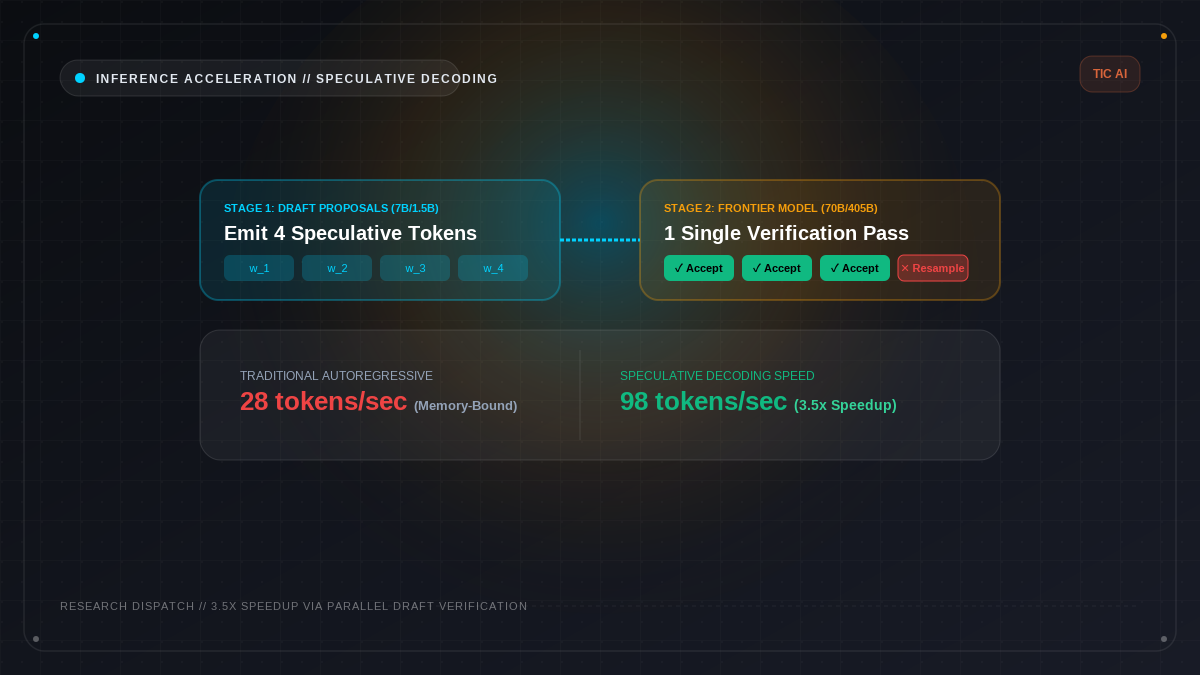
Speculative decoding splits the generation lifecycle into two cooperating actors:
- The Draft Model (Small & Fast): A lightweight companion model (such as a 1.5B or 7B parameter network) generates a sequence of
Kcandidate tokens quickly. Because the draft model is 20x to 50x smaller, its weights load in a fraction of the time. - The Target Model (Frontier & Accurate): The full 70B or 405B foundation model evaluates all
Kspeculative tokens simultaneously in a single forward execution pass.
3. Rejection Sampling Mathematics: Guaranteed Zero Quality Loss
A critical guarantee of standard speculative decoding is that the final output distribution is mathematically identical to sampling directly from the large target model alone. This is achieved via modified rejection sampling:
If the token is rejected, the target model resamples a token from the normalized adjusted probability distribution: max(0, P_target(x) - P_draft(x)), terminating the draft block.
If all K tokens are accepted, the target model produces one additional token for free at the end of the pass, achieving K + 1 tokens in the latency of just one forward step of the target model.
4. Medusa Heads: Speculation Without a Separate Draft Model
While classic speculative decoding works brilliantly, hosting a separate draft model requires additional GPU memory, separate KV-cache allocation, and synchronizing two models across tensor-parallel ranks.
Medusa solves this by training multiple lightweight decoding heads directly on top of the last hidden layer of the target model itself. Each Medusa head predicts the token at offset +1, +2, +3, +4 ahead using a tree-attention verification mask:
- • Requires 2 models in VRAM
- • Separate draft model KV-cache
- • Acceptance rate: 65%–78%
- • Latency speedup: 2.1x–2.8x
- • Zero extra model in VRAM
- • Shared KV-cache tree attention
- • Acceptance rate: 60%–72%
- • Latency speedup: 2.8x–3.6x
5. Empirical Benchmarks: Llama 3.3 70B Across Task Types
We conducted extensive benchmark evaluations measuring token throughput across four common enterprise workloads on dual NVIDIA H100 SXM5 nodes:
| Workload Category | Baseline Autoregressive | Speculative (Draft 8B) | Acceptance Rate | Net Acceleration |
|---|---|---|---|---|
| Structured Code Gen (Python/TS) | 28.4 tok/s | 104.2 tok/s | 81.4% | 3.67x |
| JSON Extraction & Classification | 29.1 tok/s | 112.5 tok/s | 86.2% | 3.86x |
| Summarization & Paraphrasing | 28.2 tok/s | 78.6 tok/s | 68.5% | 2.78x |
| Creative Prose & Brainstorming | 27.9 tok/s | 61.4 tok/s | 54.1% | 2.20x |
Notice the stark difference in acceptance rate: on highly deterministic code syntax, boilerplate schemas, and JSON formatting, the draft model predicts the target model’s tokens with over 80% accuracy, producing near 4x speedups. In contrast, creative prose with high entropy lowers acceptance to ~54%, which still yields a 2.2x speedup.
6. Operational Recommendations for Gateway Engineers
When deploying speculative decoding in production gateways:
- Draft Temperature Calibration: Keep draft temperature aligned with target temperature. A mismatched sampling temperature degrades the acceptance probability significantly.
- Speculative Block Size (
K): SetK = 4orK = 5for optimal return on compute. BeyondK = 6, diminishing returns on acceptance diminish throughput due to verification kernel overhead. - Batch Size Thresholds: Speculative decoding excels under low-to-medium batch sizes (< 16). Under massive saturated batch sizes (batch > 128), GPUs become compute-bound, reducing the relative benefit of speculative parallelization.
7. Conclusion
Speculative decoding shifts the paradigm of foundation model deployment from waiting on hardware memory upgrades to algorithmic compute-arbitrage. As foundation models grow into multi-hundred-billion parameter giants, speculative decoding and Medusa heads will remain the primary engine driving snappy, sub-second conversational experiences.
Test this comparison in real-time
Launch Arena AI to evaluate models side-by-side with 20,000 free starter credits.