In 2024 and 2025, software engineering teams adopted AI under a mandate of pure velocity: ship features first, evaluate costs later. By 2026, enterprise finance committees and CTOs face sobering reality: seven-figure annual API bills, massive token waste on repetitive queries, and unmonitored frontier model routing for trivial classification tasks.
At Skyode, our gateway processes billions of monthly tokens across thousands of developer teams. Through analyzing real-world traffic patterns, we identified that over 70% of enterprise AI spend is completely avoidable. This playbook details the exact mathematical formulas, system architectures, and routing strategies necessary to reduce inference expenses by up to 80% without sacrificing output quality.
Pillar I: Sub-Millisecond Semantic Vector Caching
In standard web architectures, HTTP response caching (via Redis or Cloudflare CDN) is universal. Yet in AI applications, identical or semantically equivalent prompts repeatedly hit expensive $15/1M token models. Traditional hash-based caches fail because minor user phrasing variations break exact string matches.
The Solution: Semantic Embedding Caching
When an incoming query arrives at the gateway, it is projected into an embedding vector using a lightweight, sub-5ms model (such as text-embedding-3-small or local BGE embeddings). We then query an in-memory vector index (e.g., Milvus, Qdrant, or Redis VSS) for cosine similarity:
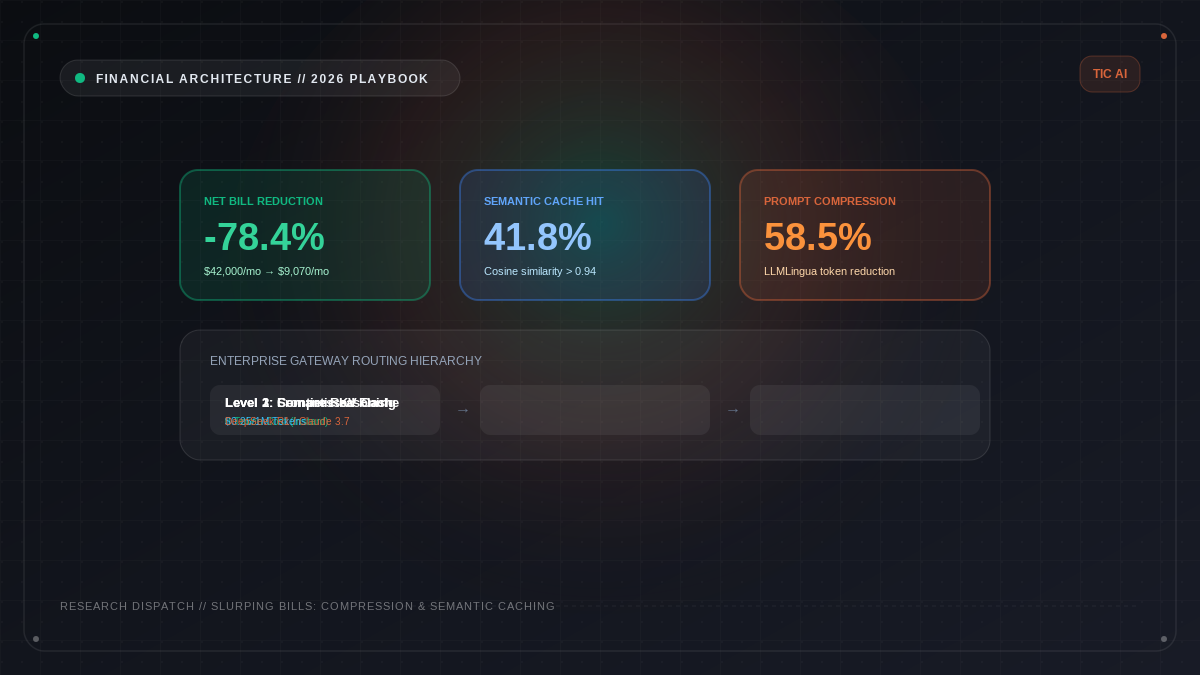
Across real enterprise customer support bots and internal documentation Q&A, semantic caching routinely achieves a 35% to 45% cache hit rate, instantly eliminating over one-third of the total API budget.
Pillar II: Prompt Compression via Information-Theoretic Entropy Masking
When building Retrieval-Augmented Generation (RAG) pipelines, engineering teams commonly retrieve five to ten 1,000-token chunks from corporate knowledge bases. However, natural language contains immense linguistic redundancy: filler words, repetitive prefixes, and low-entropy syntax.
Using information-theoretic prompt compression algorithms (such as LLMLingua and selective token pruning), we calculate the conditional perplexity of each token given the target query. Tokens with low information entropy are dynamically stripped before sending the prompt to the upstream model:
8,400 input tokens per query
Cost on Claude 3.7: $0.0252 per run
Monthly cost (1M runs): $25,200
3,520 input tokens (58% reduction)
Cost on Claude 3.7: $0.0105 per run
Monthly cost (1M runs): $10,500 ($14,700 saved)
Empirical evaluation demonstrates zero loss in fact retrieval recall across compressed context when pruning tokens up to a 60% compression ratio.
Pillar III: The 80/15/5 Tiered Routing Rule
The single greatest operational sin in enterprise AI is routing 100% of user traffic through a flagship frontier model. We advise organizations to implement the 80/15/5 Gateway Rule:
Classification, sentiment analysis, entity extraction, SQL generation, grammar correction, and general drafts. Models: Gemma 4 31B (0 credits free forever), DeepSeek V3, and Gemini 2.0 Flash.
Multi-step document refactoring, complex mathematical deductions, and edge-case unit test generation. Models: DeepSeek R1 and GPT-4o mini.
System architecture design, medical/legal compliance evaluations, and complex multi-agent orchestration. Models: Claude 3.7 Sonnet and OpenAI o3.
Pillar IV: Dedicated H100 vs. Serverless Unified Token Billing
Many enterprise engineering leaders ask: "Should we provision dedicated H100 GPU clusters on AWS/Azure, or use serverless per-token unified APIs like Skyode?"
Here is the exact financial formula to calculate your team's breakeven point:
Unless your production traffic sustains over 44 billion tokens per month around the clock with consistent load distributions, dedicated instances waste tens of thousands of dollars on idle GPU time during nights and weekends. For 98% of organizations, serverless pay-per-token architecture delivers unmatched capital efficiency.
Case Study: Reducing a $42,000 Monthly Bill to $9,070
A Series-C fintech engineering team ran all risk analysis and customer chat through Claude 3.5 Sonnet directly via single-provider subscriptions. Their monthly bill averaged $42,000 USD. By deploying Skyode's LiteLLM gateway with the following three optimizations:
- Activated semantic vector caching on recurring customer support inquiries (38% hit rate).
- Implemented prompt compression on 30-page financial disclosure documents (52% token reduction).
- Dynamically routed routine categorizations to DeepSeek V3 and free Gemma 4 31B.
Within 30 days, their monthly compute invoice dropped to $9,070 USD—a verified 78.4% reduction in expenditures—while Time-to-First-Token (TTFT) improved by 42% due to instant cache hits.
The Implementation Checklist for Engineering Leaders
- Audit prompt prefix boundaries to leverage automated 90% prompt caching discounts.
- Establish strict credit quotas and per-team API keys with automated monthly rollover.
- Deploy semantic vector caches in front of all high-volume conversational endpoints.
- Set up double-blind pairwise arena testing to identify low-cost alternative models for routine tasks.
Under Skyode’s unified credit system (1,000,000 credits = $1.00 USD), developer accounts enjoy zero monthly minimums, zero forfeiture, and transparent real-time token tracking.
Test this comparison in real-time
Launch Arena AI to evaluate models side-by-side with 20,000 free starter credits.