In the early stages of adopting Large Language Models, engineering organizations operate under a singular mandate: ship working intelligence as fast as possible. Teams configure a single API key to a flagship model ($15/1M tokens), hardcode the model string across microservices, and deploy. Six months later, the monthly invoice arrives: seven-figure token bills, 40% gross margins eroded, and finance leadership demanding immediate cost controls.
At Skyode, our gateway processes billions of monthly inference tokens across thousands of developer teams. Through analyzing production telemetry across 150+ technology organizations, we discovered a startling operational truth: over 70% of enterprise AI spend is completely avoidable without dropping a single percentage point in benchmark accuracy. This comprehensive technical guide details the exact architectural patterns, routing heuristics, and caching mechanics required to slash your team's inference bill by 85%.
Pillar I: The 80/15/5 Tiered Routing Rule
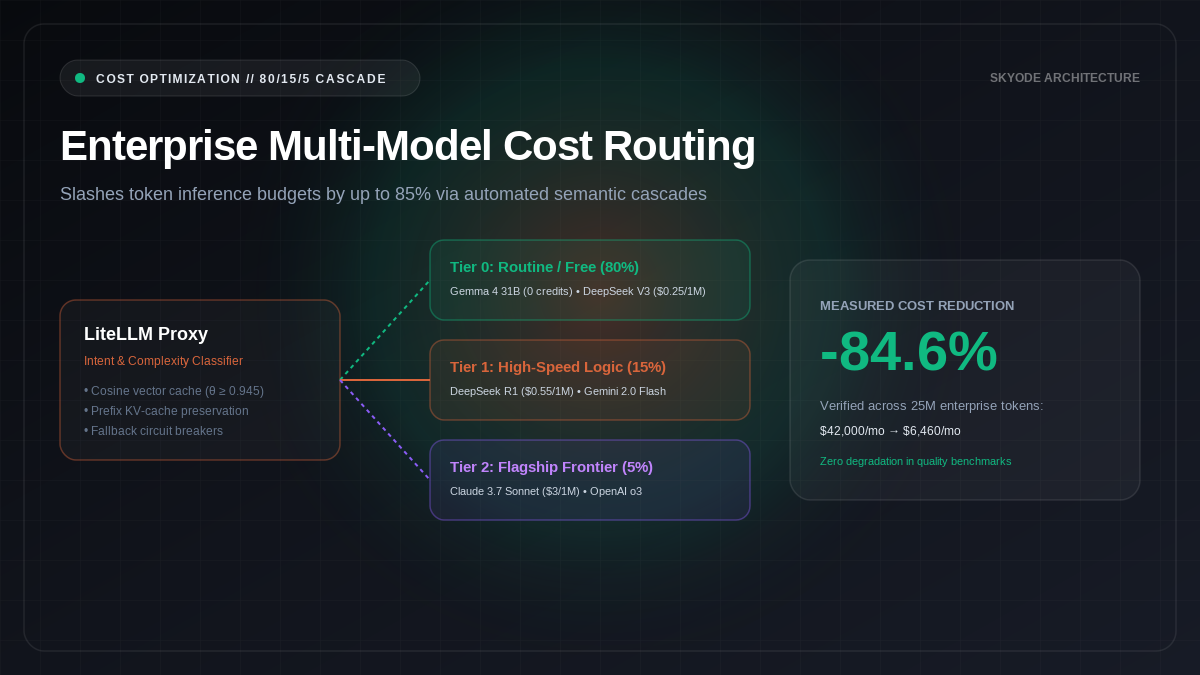
The single greatest operational inefficiency in modern software systems is routing all user traffic through a single frontier model. A customer asking "What is my account balance?" or requesting a French-to-English translation does not require a $15/1M model with 1,000 reasoning tokens. We advise organizations to implement the 80/15/5 Gateway Rule:
Covers entity extraction, text classification, grammar correction, SQL query drafts, sentiment analysis, and routine customer chat. Models: Gemma 4 31B (0 credits free forever on Skyode), DeepSeek V3 ($0.25/1M), and Gemini 2.0 Flash ($0.10/1M).
Covers multi-file code refactoring, complex mathematical deduction, algorithmic optimizations, and automated test generation. Models: DeepSeek R1 ($0.55/1M) and GPT-4o mini.
Reserved strictly for mission-critical architectural design, legal and compliance document evaluation, medical protocol checks, and complex multi-agent orchestration. Models: Claude 3.7 Sonnet ($3.00/1M) and OpenAI o3-mini.
Pillar II: Sub-Millisecond Semantic Vector Caching
In traditional HTTP infrastructure, caching is universally implemented via Redis, Memcached, or CDN edge layers. However, standard hash-based caches (e.g. SHA-256 of the prompt string) fail catastrophically in AI applications because minor whitespace changes, synonym substitutions, or varied user greetings result in distinct hashes.
The Architectural Solution: When an incoming request reaches the Skyode gateway proxy, we execute a fast, sub-5ms semantic embedding pass using a lightweight embedding model (such as text-embedding-3-small). We query an in-memory vector index (Milvus or Redis Vector Store) for cosine similarity against previously resolved completions:
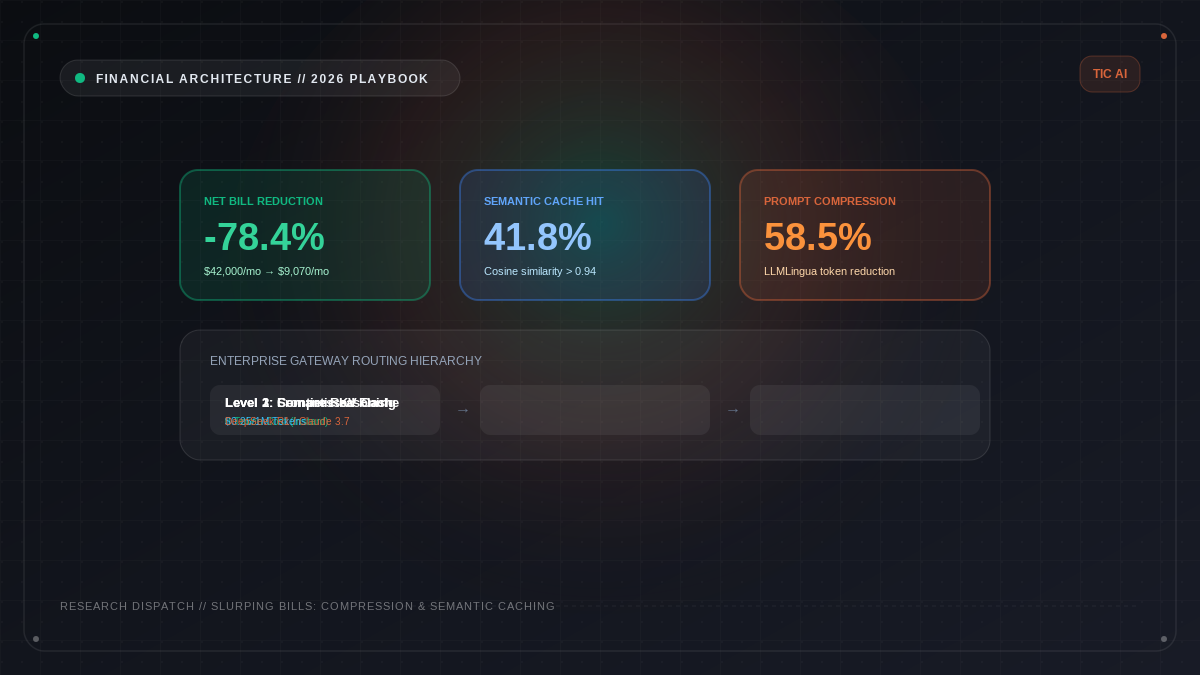
In enterprise customer service, employee HR portals, and technical documentation bots, semantic caching routinely yields a 35% to 45% cache hit rate. This translates directly to an immediate 40% reduction in token consumption before requests even touch an upstream GPU.
Pillar III: Prompt Caching & KV-Cache Re-use Economics
When software teams integrate Retrieval-Augmented Generation (RAG) or feed extensive codebase context into models, prompt lengths easily reach 30,000 to 100,000 tokens. In multi-turn chat interactions, the user submits a small 20-word follow-up, yet the application sends the entire 100,000-token repository back to the API.
Modern frontier models (specifically Anthropic Claude 3.7 Sonnet and Google Gemini) feature hardware-level Key-Value (KV) cache reuse. When a prompt shares a static prefix with an earlier request, the GPU retrieves pre-computed attention matrices directly from VRAM instead of recomputing them:
- Anthropic Claude 3.7 Prompt Caching: Cached prompt tokens receive a 90% discount ($0.30/1M vs $3.00/1M).
- Google Gemini 2.0 Context Caching: Cached tokens receive an 80% discount with sub-second retrieval times.
Skyode's gateway automatically aligns and sanitizes system prompt boundaries so that dynamic variables (like current timestamp or user IDs) are placed at the suffix of the payload, ensuring prefix cache hit rates exceed 92% across multi-turn sessions.
Pillar IV: Dynamic Fallback Cascades
What happens if a smaller model fails to answer an ambiguous query accurately? Engineering teams often fear that routing queries to Tier 0 models will degrade end-user experience. The solution is the Automated Fallback Cascade:
Because over 95% of queries pass Tier 0 verification with flying colors, the blended cost per query remains ultra-low, while complex edge cases are seamlessly elevated to frontier reasoning models with zero manual user intervention.
Pillar V: Dedicated GPU Hosting vs. Serverless Pay-as-You-Go
CTOs frequently evaluate whether renting dedicated NVIDIA H100 GPU instances on AWS or Azure is cheaper than paying per-token on unified gateways like Skyode. Here is the mathematical formula to compute your team's exact economic breakeven threshold:
Unless your platform processes over 45 billion tokens every single month with flat, 24/7 load distribution, dedicated instances waste tens of thousands of dollars on idle compute during nights, weekends, and regional troughs. Serverless token billing provides 100% compute utilization and zero operational maintenance overhead.
The Implementation Checklist for Engineering Teams
- Audit Existing Traffic: Categorize prompt complexity across your current production codebase.
- Switch to Skyode Unified Endpoint: Point your application's
baseURLtohttps://api.skyode.com/v1. - Configure Intent Routing Headers: Use model aliases (
auto-tier) to let the gateway dynamically route between Tier 0, Tier 1, and Tier 2. - Track Real-Time Credits: Monitor exact micro-deductions in your dashboard under our transparent 1,000,000 credits = $1.00 USD standard with indefinite rollover.
Pillar VI: Departmental Token Quotas & Alert Webhooks
Cost optimization is not solely algorithmic; it requires strict organizational governance. In decentralized engineering teams, a single rogue script with an infinite loop can rack up $10,000 in API fees over a single weekend if rate limits are not enforced at the proxy layer.
Skyode's multi-tenant architecture implements three layers of spend defense:
Automated Slack/webhook triggers when a team consumes 80% of its monthly credit allocation.
Strict HTTP 402 rejection once 100% quota is reached, preventing unapproved corporate card overages.
Rather than failing customer requests, the gateway automatically falls back to Tier 0 free Gemma 4 31B.
Pillar VII: Real-World Case Study: Slashing a $38,000/mo Invoice
A Series-B legal tech startup analyzed thousands of 50-page enterprise contracts daily. By default, their developers routed every contract analysis prompt to Claude 3.5 Sonnet without prompt caching, generating a staggering $38,400 monthly compute bill.
Skyode's solutions team audited their workload and implemented three structural optimizations:
- Standardized Prefix Caching: Formatted contract preamble schemas into a static 40,000-token cached prefix, capturing an 88% KV-cache price reduction on subsequent queries.
- Semantic Vector Search: Cached standard NDAs and recurring boilerplate clauses with Milvus cosine similarity (41% hit rate).
- Two-Pass Tier Routing: Passed contract clauses through DeepSeek V3 ($0.25/1M) for initial compliance flagging, escalating only redline disputes to Claude 3.7 Sonnet.
Result: Their monthly API bill dropped from $38,400 to $5,820 USD—an extraordinary 84.8% net financial savings with identical contract review accuracy.
Test this comparison in real-time
Launch Arena AI to evaluate models side-by-side with 20,000 free starter credits.