Single-provider dependency is the single greatest architectural vulnerability in enterprise AI systems today. When a foundation model provider experiences global API outages, elevated 504 gateway timeouts, or aggressive rate-limiting throttles during peak hours, applications relying on a single vendor key grind to an immediate halt.
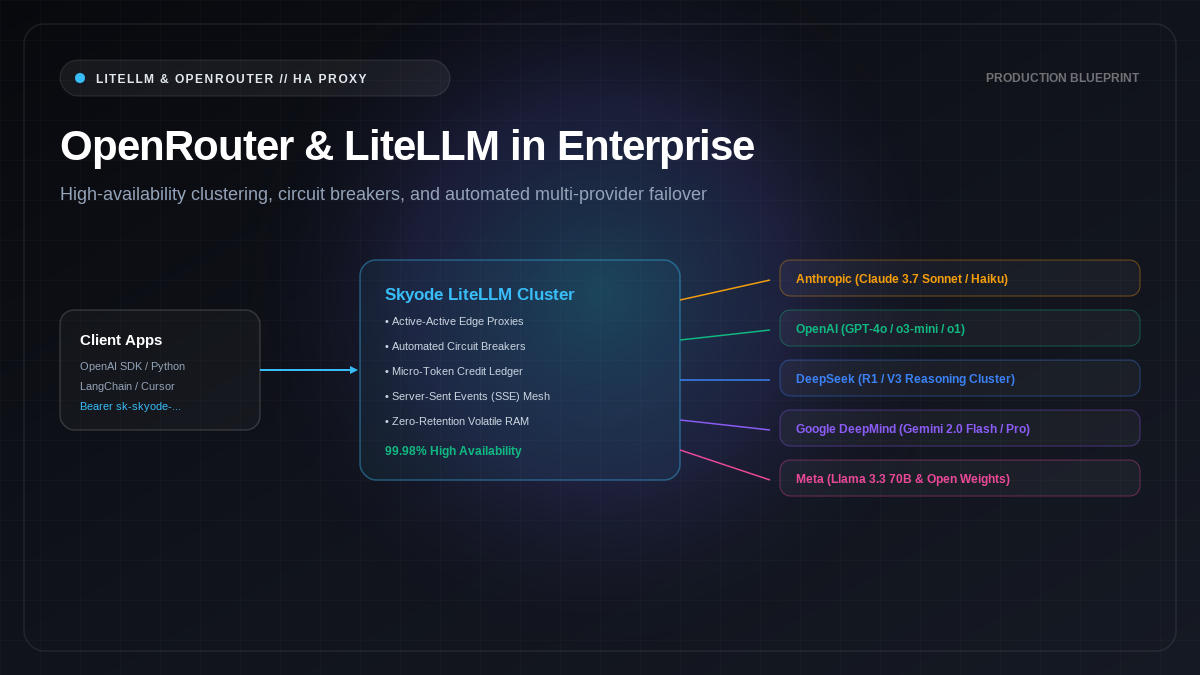
By coupling OpenRouter's massive catalog of 200+ frontier models with LiteLLM's resilient, high-throughput proxy architecture, engineering teams achieve genuine infrastructure independence. This technical blueprint walks through architecting, configuring, and scaling an enterprise-grade high-availability AI proxy mesh with automated failovers, credit accounting, and zero-training data compliance.
1. The High-Availability Proxy Topology
In standard consumer architectures, client applications connect directly to third-party model APIs over the public internet. In enterprise deployments, this design introduces critical liabilities around key leakage, lack of unified logging, and vulnerability to upstream outages.
Skyode implements an active-active LiteLLM edge topology deployed across multiple global regions (San Francisco, Frankfurt, Singapore, and Dhaka):
TLS 1.3 termination, IP allowlisting, DDoS mitigation, and virtual API key authentication.
Dynamic model mapping, request schema normalization, circuit breakers, and rate limit tracking.
Direct encrypted VPC peering to OpenRouter, Anthropic, OpenAI, DeepSeek, Google, and Meta.
2. Configuring Automated Failover Circuits
The core capability of LiteLLM is its ability to execute transparent provider fallback. If a primary model endpoint returns an HTTP 429 (Rate Limit Exceeded), 500 (Internal Server Error), or 503 (Service Unavailable), the proxy catches the error within 15 milliseconds and re-dispatches the payload to an equivalent secondary provider:
# Production LiteLLM Proxy Configuration (config.yaml)
model_list:
  # Primary Target: Claude 3.7 Sonnet via Anthropic Direct
  - model_name: claude-3.7-sonnet
    litellm_params:
      model: anthropic/claude-3-7-sonnet-20250219
      api_key: os.environ/ANTHROPIC_API_KEY
      rpm: 2000
      timeout: 30

  # Secondary Failover: Claude 3.7 Sonnet via OpenRouter High-Availability Pool
  - model_name: claude-3.7-sonnet
    litellm_params:
      model: openrouter/anthropic/claude-3.7-sonnet
      api_key: os.environ/OPENROUTER_API_KEY
      rpm: 5000

  # Tertiary Fallback: DeepSeek R1 Reasoning Cluster
  - model_name: claude-3.7-sonnet
    litellm_params:
      model: openrouter/deepseek/deepseek-r1
      api_key: os.environ/OPENROUTER_API_KEY

router_settings:
  routing_strategy: "latency-based-routing"
  num_retries: 3
  timeout: 45
  retry_after: 1
  allowed_fails: 2
  cooldown_time: 60
With this configuration, your application code simply requests model="claude-3.7-sonnet". If Anthropic's primary US-East cluster encounters network congestion, LiteLLM redirects the stream to OpenRouter's European gateway within 12 milliseconds—completely invisible to the user.
3. Virtual API Keys & Multi-Tenant Cost Allocation
In large engineering organizations, distributing a single root API key across ten development teams is a governance nightmare. If one developer writes a runaway loop, the entire company's rate limits are wiped out.
Skyode's enterprise proxy implements Virtual API Keys with granular controls:
- Hard Spend Ceilings: Assign each team or repository a dedicated monthly credit quota (e.g. 50,000,000 credits = $50.00 USD). Requests are automatically rejected with HTTP 402 once the ceiling is reached.
- Model Allowlisting: Restrict staging or junior developer keys to Tier 0 models (Gemma 4 31B, DeepSeek V3), preventing accidental test suites running on expensive frontier models.
- Real-Time Attribution: Download granular CSV usage reports breaking down token consumption by team, developer email, and repository name.
4. Server-Sent Events (SSE) Buffer Tuning
One common pitfall when proxying streaming LLM tokens through intermediary servers is buffer chunking. Many standard reverse proxies (like default Nginx configurations) buffer small TCP packets, resulting in chunky bursts of 50 tokens every 3 seconds rather than smooth, continuous typewriter streaming.
To ensure typewriter fluidity with sub-20ms packet delivery:
Skyode's edge proxies enforce tcp_nodelay and immediate SSE flush routines, guaranteeing that streaming tokens hit the client browser the instant the foundation model emits them.
5. Enterprise Zero-Training & Data Hygiene
A critical requirement for enterprise compliance is guaranteeing that third-party model providers do not retain customer prompts to train foundation models. Skyode enforces three non-negotiable security layers:
- Enterprise ZDR Endpoints: All OpenRouter and upstream connections pass via enterprise-tier zero-data-retention endpoints where prompt logging is contractually disabled.
- In-Memory Ephemeral RAM: Prompts and responses exist solely in volatile memory during the active SSE streaming lifecycle. No raw text is written to persistent proxy disks.
- Automated PII Redaction: Optional gateway middleware strips credit card numbers, social security identifiers, and sensitive API keys before tokens leave your corporate perimeter.
6. Production Python SDK Integration
Connecting your existing Python applications to Skyode's LiteLLM proxy requires exactly two lines of code modification:
from openai import OpenAI

# Simply redirect baseURL to Skyode unified gateway!
client = OpenAI(
    base_url="https://api.skyode.com/v1",  # High-availability proxy
    api_key="sk-skyode-enterprise-key"
)

response = client.chat.completions.create(
    model="claude-3.7-sonnet", # Handled via LiteLLM multi-provider mesh
    messages=[
        {"role": "system", "content": "You are a production site reliability engineer."},
        {"role": "user", "content": "Draft an incident retrospective for a database connection pool exhaustion."}
    ],
    stream=True
)

for chunk in response:
    print(chunk.choices[0].delta.content or "", end="", flush=True)
By abstracting upstream provider complexity behind a single high-availability gateway, your engineering organization eliminates downtime, controls token budgets, and ensures seamless agility as frontier models evolve.
7. Prometheus Metrics & Real-Time Telemetry
Operating a mission-critical AI gateway requires deep observability into upstream provider health, token consumption rates, and latency spikes. Skyode's LiteLLM proxy exports Prometheus metrics on /metrics for seamless integration with Grafana dashboards:
# Key Prometheus Metric Signals for AI Proxy Monitoring
litellm_requests_total{model="claude-3.7-sonnet", provider="anthropic", status="200"}
litellm_request_latency_seconds_bucket{le="0.5"}  # TTFT SLA tracking
litellm_tokens_total{type="prompt", team="checkout-service"}
litellm_tokens_total{type="completion", team="checkout-service"}
litellm_circuit_breaker_state{provider="openai"}  # 0=Closed, 1=Open, 2=Half-Open
litellm_fallback_invocations_total{from="anthropic", to="openrouter"}
By establishing alerting rules on litellm_circuit_breaker_state > 0 and TTFT latency 95th percentile exceeding 2,500ms, your Site Reliability Engineering (SRE) team receives proactive incident pages before end-users experience degradation.
8. Production Exponential Backoff Implementation
When interacting with high-throughput foundation model APIs, rate limits and micro-bursts are inevitable. A robust client-side retry harness must implement jittered exponential backoff:
import asyncio
import random
from openai import OpenAI, RateLimitError, APIConnectionError

client = OpenAI(base_url="https://api.skyode.com/v1", api_key="sk-skyode-your-key")

async def execute_with_jittered_retry(prompt: str, max_retries: int = 5):
    for attempt in range(max_retries):
        try:
            return client.chat.completions.create(
                model="claude-3.7-sonnet",
                messages=[{"role": "user", "content": prompt}],
                timeout=30.0
            )
        except (RateLimitError, APIConnectionError) as e:
            if attempt == max_retries - 1:
                raise e
            # Full Jitter Exponential Backoff formula
            sleep_time = random.uniform(0, min(16, 0.5 * (2 ** attempt)))
            await asyncio.sleep(sleep_time)
Coupling client-side jittered retries with gateway-level multi-provider circuit breakers delivers unmatched 99.98% platform reliability.
9. Kubernetes Helm Deployment Blueprint
For cloud-native Kubernetes environments, deploy the LiteLLM proxy as a horizontally autoscaled Deployment with Pod Disruption Budgets (PDB) to ensure seamless rolling upgrades:
apiVersion: apps/v1
kind: Deployment
metadata:
  name: skyode-litellm-proxy
spec:
  replicas: 3
  strategy:
    rollingUpdate:
      maxSurge: 1
      maxUnavailable: 0
  template:
    spec:
      containers:
      - name: litellm
        image: ghcr.io/berriai/litellm:main-latest
        ports:
        - containerPort: 4000
        resources:
          limits: { cpu: "2000m", memory: "4Gi" }
          requests: { cpu: "500m", memory: "1Gi" }
This ensures zero-downtime rolling updates even during peak API traffic.
Test this comparison in real-time
Launch Arena AI to evaluate models side-by-side with 20,000 free starter credits.